
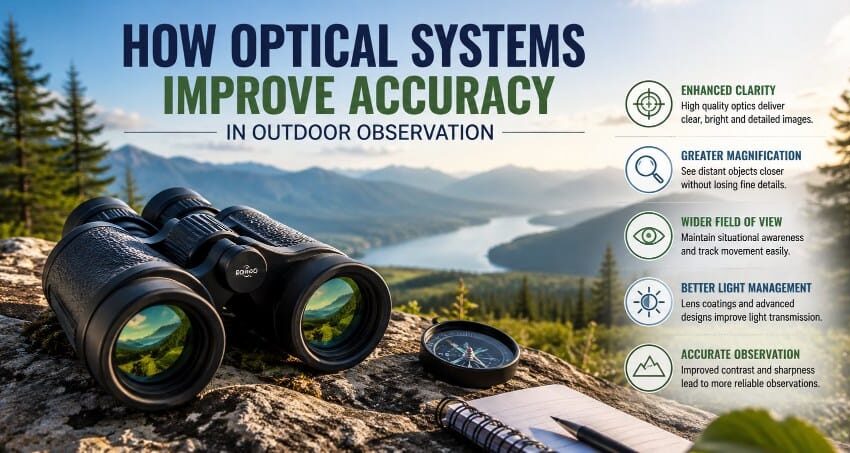
Outdoor observation often depends on more than simply having good eyesight. Whether someone is studying wildlife, monitoring landscapes, conducting environmental research, or exploring distant objects, the ability to see details clearly can make a significant difference. Natural conditions such as distance, changing light, weather, and visual obstructions can make accurate observation difficult.
This is where optical systems become important. Optical systems are designed to control and improve the way light travels from an object to the observer’s eye. Through lenses, magnification, focusing mechanisms, and specialized optical engineering, these systems can make distant or unclear subjects easier to examine.
Understanding how optical systems improve accuracy in outdoor observation helps explain why they are widely used in fields such as nature study, environmental monitoring, astronomy, surveying, and outdoor research.
What Does Accuracy Mean in Outdoor Observation?
Before examining optical technology, it is useful to understand what “accuracy” means in an outdoor observation context.
Accuracy refers to the ability to identify, examine, and interpret a subject correctly. It does not simply mean seeing something from a greater distance. A person may be able to notice a distant object but still be unable to distinguish its important details.
For example, an observer may see a bird sitting on a distant branch. However, identifying its markings, behavior, or physical characteristics requires a clearer view. Similarly, an environmental researcher may need to distinguish between different types of vegetation across a landscape.
Optical systems improve accuracy by helping the observer see more detail, with greater clarity and consistency.
The Role of Light in Optical Observation
Optical systems are designed to control and improve the way light travels from an object to the observer’s eye, helping modern optical systems deliver clearer visual information in demanding outdoor environments.
Bright sunlight, shadows, fog, and cloudy conditions all affect how clearly an object can be seen. Optical systems are designed to manage the available light and direct it more effectively toward the eye.
The quality of lenses and the overall design of an optical system influence how light is transmitted. When light is handled efficiently, the resulting image can appear clearer and more defined.
This is especially important during outdoor observation because natural lighting is rarely perfectly consistent. A system that performs well under changing conditions can help the observer maintain a more reliable view.
Magnification and the Ability to Examine Distant Details
One of the most recognizable features of many optical systems is magnification. Magnification makes distant subjects appear closer, allowing the observer to examine details that would normally be difficult to see with the naked eye.
However, magnification is not simply about choosing the highest possible level. Excessive magnification can make an image more difficult to manage, particularly when the observer is trying to follow movement or maintain a stable view.
Effective optical design balances magnification with image clarity and usability. The goal is to provide a useful level of detail without making observation unnecessarily difficult.
For outdoor researchers and nature observers, this balance can be particularly valuable. A clear, moderately magnified image may provide more useful information than a highly enlarged but unstable or unclear view.
Field of View and Situational Awareness
Field of view refers to the amount of an area that can be seen through an optical system. This feature has a direct impact on observation accuracy.
A wider field of view allows an observer to see more of the surrounding area at once. This can be helpful when studying moving wildlife, monitoring a large landscape, or observing a changing outdoor environment.
A narrow field of view, on the other hand, may provide more focused viewing of a specific area but can make it harder to follow movement or understand the surrounding context.
Optical systems are therefore designed with different field-of-view characteristics depending on their intended use. Understanding this factor helps explain why optical performance cannot be judged by magnification alone.
Focus and Image Sharpness
Focus is another essential element of accurate observation. Even a well-designed optical system cannot provide useful information if the image is not properly focused.
A focusing mechanism allows the observer to adjust the image according to the distance of the subject. This is particularly important in outdoor environments, where the distance between the observer and the subject can vary significantly.
Accurate focusing helps separate fine details and makes the image easier to interpret. For example, a researcher examining natural features may need to distinguish between objects that appear close together from a distance.
Sharpness is also influenced by the optical design itself. Well-engineered systems are designed to reduce visual distortions and maintain a consistent image across the viewing area.
Lens Coatings and Improved Light Transmission
Modern optical systems often use lens coatings to improve the way light passes through the optical components. These coatings can help reduce unwanted reflections and improve light transmission.
Reflections may reduce the amount of light reaching the eye. They can also create visual distractions, particularly in bright outdoor conditions.
By controlling these effects, lens coatings can contribute to a clearer and more balanced image. This does not mean that an optical system can completely eliminate the effects of poor weather or extreme lighting. Instead, it can help the system use available light more efficiently.
The science behind lens coatings demonstrates how small changes in optical engineering can influence the overall observation experience.
Reducing Optical Distortion
Optical distortion occurs when an image does not appear exactly as it should. Straight lines may appear curved, edges may look unusual, or different parts of an image may appear inconsistent.
These distortions can make it harder to interpret what is being observed. In scientific or environmental applications, even small visual inconsistencies may affect the observer’s understanding of a subject.
Optical engineers use different design principles to reduce distortion and improve image consistency. The aim is to produce an image that more accurately represents the observed environment.
This is one reason why optical system design involves much more than simply placing lenses together. Each optical component must work as part of a carefully calculated system.
How Weather Conditions Affect Observation
Outdoor observation is heavily influenced by weather. Fog, rain, humidity, and temperature changes can all affect visibility.
Atmospheric conditions may scatter or absorb light, reducing contrast between an object and its surroundings. This can make distant subjects more difficult to distinguish.
Optical systems cannot change the weather, but their design can influence how effectively an observer uses the available visual information. Clear optics, appropriate focusing, and efficient light management may help preserve a more usable image under changing conditions.
The observer’s own understanding of weather and atmospheric effects is equally important. Optical equipment works best when combined with realistic expectations about environmental conditions.
The Importance of Contrast
Contrast refers to the difference between light and dark areas within an image. Stronger contrast can make edges and details easier to distinguish.
In outdoor environments, contrast may change constantly. A subject may appear against bright sunlight, dark vegetation, or a shadowed background.
Optical systems are designed to provide a balanced image that helps the observer distinguish important details. However, contrast is influenced by many factors, including lighting, atmospheric conditions, and the subject itself.
Understanding contrast is particularly useful for anyone involved in wildlife observation or environmental study. It explains why two objects of similar size may be easy to distinguish in one situation but difficult to see in another.
Optical Systems and Human Vision
The human eye is highly capable, but it has natural limitations. Distance, light conditions, and the size of a subject can all affect what a person can see clearly.
Optical systems work by complementing human vision. They collect, focus, and direct light in a way that allows the eye to examine visual information more effectively.
This relationship between technology and human vision is important. An optical system does not replace the observer’s judgment or knowledge. Instead, it provides better visual information for the observer to interpret.
In this sense, accuracy depends on both the optical system and the person using it.
Why Optical Design Matters in Outdoor Research
Outdoor observation is used in many areas of research and practical study. Scientists may observe wildlife behavior, environmental changes, or geological features. Surveyors may examine distant locations, while nature enthusiasts study animals and landscapes.
In each case, the quality of visual information can influence the quality of the observation.
Optical design improves the observer’s ability to collect that information. Features such as magnification, focus, field of view, and light transmission work together to produce a more useful image.
The key point is that no single optical feature is responsible for accuracy. Instead, accurate observation is the result of multiple design elements working together.
Conclusion
Optical systems improve accuracy in outdoor observation by helping people see distant subjects, examine fine details, and interpret visual information more clearly. Magnification, focusing, field of view, lens coatings, contrast, and distortion control all contribute to the quality of the observed image.
However, optical technology is only one part of accurate observation. Environmental conditions, observer experience, and careful interpretation also play important roles.
The science of optical systems shows how carefully engineered technology can support human vision in challenging outdoor environments. By managing light and improving image quality, optical systems make it easier to study and understand the world beyond the limits of unaided eyesight.
