

introduction to Lab Automation news and its growing importance
The current lab environment is constantly challenged to produce high-quality results as quickly as possible. Scientists typically spend much of their time performing repetitive tasks, including diluting liquids using pipettes, recording the location of samples, or double-checking processes; rather than performing meaningful analysis. This operating burden within the lab creates inefficiencies in the lab and increases the risk for error.
Lab Automation news can solve these problems by automating the repetitive aspects of laboratory work, allowing people to focus their time and resources on higher value tasks, such as interpreting results or designing experiments.
Automated processes ensure consistent and reliable results. Machines can consistently repeat tasks without the possibility of variance due to fatigue or distraction. Digital systems are capable of automatically tracking samples, reagents and workflows; thus, providing traceability and compliance. This capability will be invaluable to the clinical, research and pharmaceutical industries, where accuracy and documentation are key requirements in all respects.
As a basic rule, starting small has proven to produce good results. Labs that would like to implement an automation solution typically implement a single workflow (e.g., sample handling, data entry) to realize the cost and efficiency advantages of automation and then expand automation over time to include additional processes within the lab in order to achieve efficiencies throughout the entire laboratory.
Ultimately, Automation is not about replacing scientists but rather enabling them to be more operationally efficient by removing repetitive processes from their workflow, thereby giving laboratories greater efficiency and precision in the work they perform through more effective oversight of the data generated during their workflow, ultimately resulting in the ability to produce smarter, faster and more reliable
Evolution of laboratory automation from manual to smart system
Laboratories have evolved greatly overtime. Previously, laboratories relied mainly upon manual processes (taking notes, hand-preparation of samples, logging everything) when completing tasks. Early automated devices (pipetting devices; plate readers) assisted in easing the workload on laboratory personnel while providing additional convenience; however, the completed specimens would still require manual entry, which resulted in data siloing. The next evolution consisted of an increase in automated robotics and sample-handling equipment used to conduct repetitive tasks. The use of repeatable tasks saved time and increased accuracy; however, the automation occurred without laboratory personnel collaborating across a network thereby preventing laboratory teams from merging their results easily together to gain an accurate/holistic picture of the laboratory’s performance; thus, creating limitations on the utility of automation. The current automated laboratory system consists of many integrated automated devices that collaborate across multiple software and hardware systems/workflows. Furthermore, all automated devices work together, the workflow is known, and every action is automatically recorded (i.e., sample tracking; temperature/humidity monitoring) via tracking software. The use of sophisticated automation systems eliminates the need for continuous monitoring by laboratory personnel, as deviations are automatically identified by the automation software. From my professional experience, implementing a smart automated laboratory requires patience; initiate with a single workflow, then assess how that workflow converts into an automated workflow, and then continually expand the functionality of your automated workflows. As you continue to automate your workflows, you will notice improvements in your operations (decrease in human errors/increased productivity) as your staff will place value on performing hands-on, higher value-added tasks versus performing the same repetitive tasks continuously. Today’s automated laboratory operates as more than a collection of machines; today’s automated laboratory creates a smart, efficient laboratory environment.
Trends Driving Lab Automation News in 2026 and Beyond
several trends that currently shaping laboratory automation.
Firstly, the amount of data being generated is continuing to grow exponentially. Data from genomics testing, high-throughput screens and personalized medicine creates huge amounts of data which cannot be handled adequately by manual methods. Automating these processes helps the laboratory system keep pace with the increasing data volumes without sacrificing the quality of the work.
Second, there is an increase in the scarcity of skilled laboratory personnel. As a result of this trend, by automating repetitive tasks, scientists are able to focus their time on analytical vs. routine preparation which both increases productivity as well as assists in retaining the talent of the scientific workforce.
Third, the rising expectations from regulatory entities require that laboratories have adequate levels of traceability, timestamped records and accurate reporting. Automated systems provide the compliance documentation necessary to successfully audit the laboratory system in the course of performing their daily workflows.
Fourth, a major focus area for laboratories is the integration of technology solutions within the lab system. Cloud-based applications, connected laboratory instruments, and digital dashboard interfaces are being utilized by laboratories to manage their multiple location laboratory operations, experiments, and workflow processes. By providing a standardized, systematic, & scalable means for conducting laboratory workflows; the implementation of automated systems will facilitate previously unachievable laboratory automation quotas in a fully manual environment.
As laboratories embrace these different trends in laboratory automation, they quickly see tangible financial and operational benefits; even the smallest laboratory automation efforts have resulted in reduced error rates, faster time to obtain results, and increased free time for the laboratory workforce. The significant and continuous transformation of the laboratory, and the positive impact on laboratory productivity, is why the laboratory automation industry offers up such excitement to follow and monitor.
How Automation Helps Improve an Laboratory’s Accuracy, Speed and Productivity
Automation affects laboratories through three key areas of improvement, accuracy, speed and productivity. Machines provide consistent performance on the same type job repeatedly thus reducing human error. An example would be the automated liquid handling system that eliminates different results from an assay caused by fatigue and or distraction.
The improvement in speed is another distinct benefit. Because automated systems operate continually,24/7, while completing complete test procedures, laboratory personnel can now perform task that were previously completed manually in days. An example, in one laboratory that I observed, both the time needed to complete the sample processing for routine assay has been reduced by 50% in the few weeks since the introduction of an automated liquid handler.
The improvement in productivity can be attributed to the amount of time research scientists will be able to spend on tasks that require the use of their time to evaluate data, plan experiments, and troubleshoot results will increase significantly because the amount of time required for them to perform each task will be reduced. Therefore the total volume of work will continue to increase without adding any additional laboratory personnel.
For laboratories that are just beginning to implement automation; start by automating one critical procedure, track the time and error improvements, and scale the implementations gradually. The cumulative improvements in accuracy, speed, and efficiency will result in dramatic and positive results. Automation will not replace the decision-making ability of personnel; it increases the available decision making ability thereby allowing laboratory staff to spend their time on the scientific processes that will produce the required scientific results.
Artificial Intelligence & Data Analytics Impact on modern Lab automation news
The laboratory operations are being transformed with the new technologies brought about by artificial intelligence (AI) and data analytics (DA). General automation can only perform the same repetitive task repeatedly, where AI can provide the ability to analyze patterns, anticipate errors, and provide suggestions for improvements to work flow before any errors occur by using the predictive capability of AI to increase efficiency and reduce the risk of costly mistakes.
The analyses made using DA also allow laboratories to view trends over time. One example would be if there were subtle changes in temperature that can correlate with sample quality. By utilizing historical data, laboratories can adjust their protocols to prevent error prior to occurrence.
The combination of automation and AI creates a “smarter” lab; scientists can spend less time reacting to issues and more time either interpreting their results or refining their methods. Within a research environment, the use of AI powered automation allows for faster iterations of experiments, leading to increased productivity and better results.
From my observation, laboratories that are able to successfully implement an AI capability are not only able to demonstrate improved productivity but also participate in the cultural transformation of their laboratory. Employees become more confident, errors begin to decrease, and workflows move from a reactive mode to a proactive mode. AI is not replacing scientists, but providing the tools that allow for smarter functionality of their work.
Implementation of Automation within Clinical, Research, & Biopharma Laboratory Environments
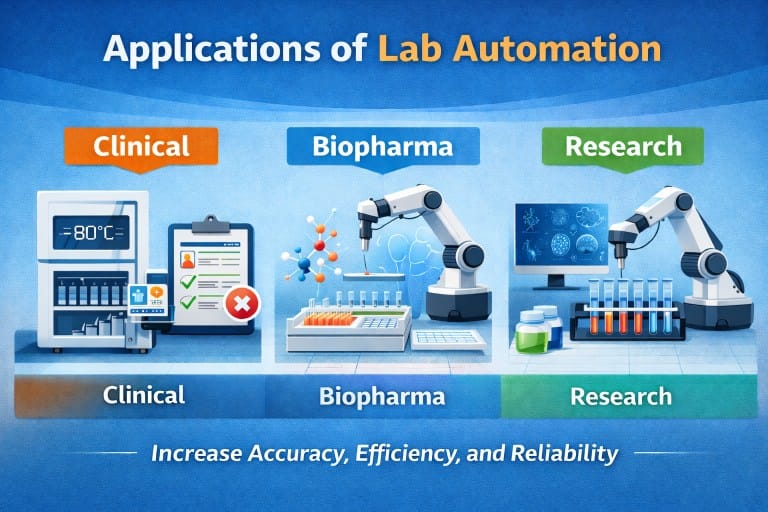
Automation provides a different benefit for the 3 types of laboratories. In the clinical laboratory environment, sample processing using automation minimizes human error and reduces the time required to complete testing which is critical to providing accurate diagnostics for patients. Research laboratory environments will benefit by being able to conduct more high-throughput experiments and provide scientists with the ability to test more hypotheses without increasing manual workload and improving timelines for discovery. In the biopharma laboratory environments, automation is the only assurance of reproducibility of results across a long period of time during the development of each drug or biologic and therefore is, by default, mandatory to the success of producing safe and effective medicines.
While the use cases for automation are different among laboratories, the improvement in efficiency and quality across all laboratory types from the use of automation are identical. Automation will allow teams to increase their capacity of operations and continue to produce accurate results.
Intelligent Temperature Control, Sensoring & Compliancy Solutions.
Monitoring the environment, including temperature, humidity, and gas, is critical in the laboratory for maintaining adequate storage conditions for sensitive materials. Automating the management of your environment will ensure proper conditions are maintained over time and eliminate both sample loss due to the failure of your condition monitoring or errors made during condition monitoring tasks.
Through the use of intelligent sensors, critical conditions monitored easily.Staff will receive an alert as soon as a critical threshold is breached, allowing for immediate intervention and identifying the cause of the problem. The automated logging of every environmental condition change will provide you with the data necessary to demonstrate compliance with local, federal and/or international regulations.
During a recent visit to one laboratory, an automated environmental condition monitoring system notified the laboratory when a freezer began to malfunction so that samples had not yet been negatively impacted.
Automated environmental condition monitoring systems will further simplify the compliance process by generating time and date stamped; detailed environmental condition records without the use of manual entry thus decreasing the occurrence of human error as well as providing for traceability. Incorporating automated environmental condition monitoring systems into an existing laboratory workflow process will increase overall quality and efficiency.
If your organisation has decided that it would like to implement automation, begin by automating the most critical workflows associated with storage, compliance and operational processes to experience the greatest benefits immediately. Small changes in your environmental condition monitoring or logging processes can prevent very expensive mistakes and provide your employees the confidence they need to know that they are conducting reliable and consistent operations
Robotics and Smart Workflows Can Help Reduce Errors in Manual Processes
When people perform repetitive tasks, they often make mistakes. Robots are able to automate certain processes and reduce these manual errors through standardized, repeatable actions that are carried out with precision. For instance, robotic liquid handlers or plate movers ensure the sample is handled the same way every time, and therefore the variability of how the sample was handled is reduced by human error.
When using intelligent workflows, errors can also be further minimized, as they establish rules for the correct sequence of steps and for necessary validation. If a step is missed in the workflow, the system will pause the workflow process and alert a team member to the missed step. This prevents errors and ensures the integrity of the data by avoiding the costly rework associated with improper documentation or process.
From my experience, in order to maximize the benefits of automation, it is critical to have a workflow designed prior to implementing any robotics. The only purpose of automation is to optimize a process, not to correct an inefficient process. Labs that take the time to plan their workflows effectively get higher levels of robotics adoption, lower levels of errors, and quicker time to ROI.
Even simple automation projects, such as automating the transfer of samples or standardizing the steps of an assay, have quantifiable benefits. Staff members feel less burden of work, there is an increased level of confidence in the data, and labs are able to handle more work without adding risk.
Breakthrough technologies shaping the future of lab automation
In underlying technologies that are having significant impact on laboratory automation, the trend is to use flexible modular robotic technologies to develop a wide range of custom devices for starting small and scaling up over time. In addition, many labs are deploying cloud-based software to connect instruments and staff at multiple sites to allow for more efficient collaboration between them, as well as allow them to gain access to real-time data and analytics.
Another growing trend is the use of digital twins and simulation platforms to allow labs to run “what-if” scenarios that will help them understand the workflows of the lab before they actually implement the processes, thereby reducing risk and accelerating the speed of adoption of automation technologies into the lab.
As these new technologies provide the opportunity for most labs to implement automation with relative ease and with little upfront investment in capital, this enables most labs to quickly implement small, focused automation projects and create measurable improvements in their operational efficiency.
I have learned that labs that take the initiative to implement these types of solutions early in the implementation phase have a distinct competitive advantage over labs that do not. They have fewer errors, are more efficient, and provide an environment that allows lab personnel to focus on developing scientific insights versus performing repetitive tasks.
Integration of Hardware, Software & Digital Lab Ecosystem

Automation can be successfully implemented through integration. Hardware provides sample movement, Software provides data tracking, and Digital platforms connect people to their workflows. Through the integrated use of these elements together, laboratories become visible, controlled, and scalable.
Poor integration of the systems used for automation is often the cause of automation failure. For example, instruments do not provide means of communication between them, data can be fragmented, and workflows are often confusing. Successful laboratories plan their laboratory ecosystem so that all of the components used are compatible and provide a smooth flow of information between each other.
Integration Eliminates Errors and Aids Reproducibility
Through the use of integrated components, laboratories can enforce compliance and facilitate the reproducibility of their work. Digital records can assist with maintaining good records, the use of automated alerts helps to reduce errors, and central dashboards provide improved audit trails. Staff can monitor multiple experiments at one time and subsequently make more accurate operational decisions due to the improved visibility created by integrated systems in the laboratory.
Good advice: Take time to identify workflows and determine which systems require connectivity by creating a workflow mapping exercise. Incremental integration is usually better than employing an initial rush to employ fully automated solutions. By ensuring that the laboratory’s ecosystem is integrated, you should expect to see measurable results in terms of increased efficiency, increased reliability, and increased laboratory productivity
Common Challenges in Lab Automation and Solutions to Overcome Them
Laboratory Automation has many advantages, but it also has challenges for laboratories. These include high startup costs and instrument compatibility issues, as well as reluctance on the part of employees/agencies who are not accustomed to using automation. To successfully address these problems, you need to prepare an orchestrated plan for implementation and perform automation in stages or phases.
One of the most difficult challenges to overcome is automation system integration. This is where multiple machines do not communicate with each other because they run on different software platforms.
One way to work around the integration problem is to perform a workflow mapping process before purchasing any equipment. Once you know how workflows will flow throughout the laboratory, you can purchase the right (compatible) machines to automate these workflows. You can also phase-in the automation of your workflows over time rather than attempting to do all at once.
Another challenge often present in laboratories is process design. Automating a flawed process is only going to magnify the errors made within that process. A laboratory should evaluate each step of its existing protocols/procedures as well as evaluate the throughput and identify bottlenecks before moving to an automated system. Labs should typically start with only small, high-volume workflow processes, measure key performance indicators, and then scale up.
From my experience, laboratories that have been successful in overcoming these challenges have been proactive in terms of how they approached addressing them. They have had clear communication with their employees, involved employees in the decision-making process, and have continually tracked improvements as they have been made. By addressing the automation integration issues, training of users, and workflow design, laboratories can overcome challenges to their automation efforts and reap the benefits of efficient and accurate operations provided by automation.
Managing Risks And Reviving Stalled lab Automation News Project
Aside from those that are not successful, there are also failed automation projects. Usually this is the result of either the team being unable to define a successful outcome (objectives) or having inadequate budgets to achieve the outcomes they have set. To avoid future failures, risk management is essential to reestablish momentum in stalled automation projects.
The first step in managing risk is to assess the project’s objectives in order to determine if they align with your company’s overall objectives and/or with measurable results. You should identify the problems causing your automated process to stall, which may include: bottlenecks in the current process; a lack of employee knowledge and/or technical skills; or an un-optimized current workflow once it is automated. Additionally, you should complete a process flow analysis to optimize your workflow prior to its automation in order to achieve quicker success.
Another crucial component of managing risk is employee involvement. If employees see the value of the automation initiative and are adequately trained, successful implementation increases. For example: piloting the automated process; implementing on a smaller scale; and test-driven development (iterative development/testing) will also reduce the risk of automation failure and produce success quickly.
In my experience, lab automation news projects that were successfully revived focused on continuous improvement (rather than complete changes) as a means of demonstrating results and reducing effort. A combination of communication, monitoring progress, and developing a realistic timeline is how automated processes create value to the lab before they consume significant amounts of time and money.
Lab Automation news Market Growth and Industry Trends Worldwide
The global market for lab automation news is growing quickly because of the growing need for clinical diagnostic equipment, research uses and biopharma applications. There are two main reasons laboratories want greater throughput and efficiency from their processes: they need to produce results with less variability and increase compliance with regulatory requirements. Therefore, many laboratories are investing heavily in automation tools such as laboratory robotics, AI-based (or other Intelligent) platforms, cloud computing solutions, and even modular hardware solutions.
Emerging trends in this space are set to drive large-scale laboratory automation solutions across the globe. In particular, an increasing number of laboratories are utilizing the power of robotics and other automation solutions in combination with traditional laboratory processes. By doing so, labs are creating scalable environments that allow for the efficient growth of their operations without compromising quality. Furthermore, the implementation of traceable and auditable processes as dictated by regulatory authorities is driving enhanced laboratory automation adoption.
While every lab may differ slightly in their product offering, the university/college sector seems to lead the way in innovation by developing products based on integrated lab ecosystems rather than stand-alone devices or equipment. In this regard, laboratory automation vendors now offer comprehensive, end-to-end solutions incorporating hardware, software, and support services, thereby enabling labs to integrate laboratory automation technology successfully, efficiently and following regulations.
Looking ahead, I see continued positive outlooks for laboratory automation adoption rates worldwide. Adoption should increase across all markets globally, particularly as labs continue to modernize their operations in Asia-Pacific and North America. The combination of continued technological innovation coupled with the rising demand for more efficient use of laboratory processes will only perpetuate the continued adoption of lab automation tools.
Drug Discoveries and Advanced Research Models’ Ability to Automate.
Drug discovery has been revitalized through automation, streamlining the high-throughput screening of compounds and providing consistency with regards to experimental methods. Automated platforms allow for multiple samples to be processed by robots in a single day thus reducing the requirement for human labor, reducing variability in terms of outcome.
In addition, AI and data analytics are utilized in conjunction with automation to identify significant trends within larger, complex data sets. The identification of trends found through data analytics allows researchers to focus their efforts on the most promising compounds, leading to improved experimental design and ultimately reducing the timeframe from discovery to hit and the likelihood of successful hits.
Research models that utilize automated techniques (organ-on-chip systems, personalized medicine assays, etc.) benefit from the consistent nature of the handling and environment in which they are run. Errors that were previously made through manual methods and could compromise experimental results are minimised through the use of automating research methods.
Automating processes provides opportunities for researchers to concentrate on data interpretation, hypothesis testing, and innovative methodologies. Through consistent adoption of automated processes in drug development laboratories, drug developers have reported quicker timelines, lower total expenditures, and improved quality of product to be developed. Together through the use of robotic technologies, data analytics, and standardised methodology /workflow, pharmaceutical development becomes more predictable and efficient.
Trust in Automated Laboratory Data Integrity & Quality Control
Laboratory Automation news improves laboratory trust and data integrity. Machines perform repetitive tasks eliminating mistakes and producing consistent results. All actions can be digitally captured with full traceability and compliance records.
Quality control benefits from the monitoring provided by automation. Sensors can monitor real-time deviations in temperature, humidity or conditions of reagents. Immediate alerts and logging of alerts could assist laboratory staff to respond immediately to prevent the possibility of an invalid experiment.
Laboratories can increase their level of data integrity by utilizing standard procedures and digital record keeping. Audit trails, time-stamped activities, and controlled access to the systems create a level of transparency for laboratories that allow them to have more confidence in their ability to demonstrate reproducibility and comply with regulations.
In my experience, laboratories that place the highest value on these three factors have fewer repeat cycles, fewer errors, and more confidence in their results. Therefore, trust is not a product of automation but an integrated component of the system that allows both the laboratory and management to have confidence in their data when making critical business decisions.
Vendors & Solution Providers Drive Innovation in Lab Automation
Role of Vendors & Solution Providers: Key Drivers of Lab Automation news
Vendors and Solutions Providers are helping to drive the advancement of lab automation today by creating modular robotics, cloud-based artificial intelligence (AI) software, developed integrated monitoring platforms, and adaptable solutions for a wide range of laboratory environments.
Many vendors also provide complete end-to-end support, including: installation, employee training, workflow optimization & ongoing maintenance. The ecosystem approach enables laboratories to prevent issues that occur as a result of fragmented implementation.
Collaboration is another key factor driving innovation. Vendors are partnering with laboratories to co-create solutions that are specifically designed for their workflow processes including: clinical diagnostics, high-throughput screening, or biopharma research. This collaboration maximizes the likelihood that solutions will produce results; therefore, resulting in viable, governmentally sanctioned solutions.
In my opinion, the decision to engage with a vendor is not really solely based on feature set; rather, it should consider the level of support they provide, how well they can integrate into existing laboratory operations, and whether the vendor aligns with laboratory objectives. Vendors/solution providers that have close working relationships with laboratories tend to enable faster implementation, measurable increase in efficiency/productivity, and contribute to smoother overall operations.
Knowledge Sharing, Industry Events, and Future-Ready Labs
Industry conferences, workshops and event attendance all play an integral part in lab automation. They provide the opportunity for professionals to share their experience, learn about new technologies,and how to work smoothly.
Knowledge sharing speed up labs adopt new practices or technologies. When a lab manager can hear how another peer has successfully integrated an artificial intelligence, robotic or digital platform into their lab without causing disruption to their operations; it provides them insight as to the challenges involved and how to resolve the issues should they occur.
On the other side of the coin, through hands-on workshops and demonstrations, staff members will feel more comfortable using new tools. The ability to see real-world examples of what other labs have done successfully provides valuable learning opportunities and can result in fewer mistakes when laboratories are implementing automation products and produce a better return on investment for their organization.
Future-ready laboratories are focused on being adaptable and continuing education. By participating in industry events, labs will remain updated on technologies, trends, compliance, and innovative workflows. Labs that create a culture of education will have an advantage over other laboratories in being able to implement automation successfully and sustain improvements in performance for a longer period of time.
Also Read: Design and Engineering Practice – Master the Art of Modern Innovation
The Future of Laboratory Automation
Intelligent systems, improved integration, and wider access to automated devices are shaping the direction of laboratory operations. Autonomous or automated Platforms driven by artificial intelligence are frequently featured in laboratory automation news for their capabilities to anticipate mistakes, improve workflow, and produce actionable insights, without the necessity of continuous oversight. These developments will help laboratories to respond swiftly to experimental requirements.
Laboratories will be able to connect to instruments and team members worldwide via cloud solutions, allowing for remote monitoring and real-time collaboration. Robotics will become increasingly flexible, capable of processing complicated samples and performing advanced assays. As reported in laboratory automation news, predictive analytics will play a greater role in laboratory decision-making by assisting laboratories in recognizing trends and preventing interruptions to the workflow before they occur.
Sustainability is also a developing trend. The use of automation produces less waste generating reagents and requires less energy, therefore further contributing to environmentally considerate laboratory practices. Laboratory automation news indicates that these types of improvements have become more of an expected standard than an alternate upgrade.
Laboratories that invest in intelligent and integrated systems today will lead the charge into the future. By utilizing robotics, artificial intelligence, and analytics, laboratories will keep pace with their competitors while improving operational efficiencies and maintaining high-quality outputs. Following laboratory automation news will enable scientists to have knowledge of their choices for adopting new technologies so that their laboratories are future-ready.
FAQs
1. What is Lab Automation news?
News about automating laboratory tasks means doing them automatically using machines and computer programs. News articles that focus on laboratory automation highlight how it increases speed and accuracy in the laboratory setting.
2. Why is Lab Automation Important?
Manual laboratory procedures or methods are generally slower and more susceptible to human error than automated laboratory processes. According to news articles about laboratory automation, laboratory automation increases efficiency and dependability within a laboratory setting.
3.what are uses of Lab Automation ?
The biggest users of laboratory automation equipment are hospitals, pharmaceutical companies and research laboratories. Over the last two years, news articles on laboratory automation indicate that the healthcare industry is experiencing the fastest growth regarding the use of automated systems.
4. Does Lab Automation Replace People?
In most cases, no. According to laboratory automation-related news, machines do the repetitive, monotonous work while humans supervise the machines, perform complex analytical operations (analyzing) and/or interpret results.
5. Is Lab Automation Expensive?
Laboratory automation systems typically require a large initial investment; however, many news articles about laboratory automation indicate that they provide a good return on investment over time.
6. What Are The Benefits of Laboratory Automation?
Laboratory automation has three main advantages over traditional methods: less time to produce results, reduced risk of making an error and increased safety. For this reason, news articles covering laboratory automation indicate that demand continues to increase.
7. Can Small Laboratories Use Laboratory Automation?
Yes, smaller laboratories may use partial or modular laboratory automation systems. Laboratory automation-related news articles regularly feature economical methods of automating laboratory processes for smaller laboratories
Conclusion: Building Smarter, Faster, and More Reliable Laboratories
The transformation of laboratory automation news has allowed for more modern approaches and new technologies such as robotic arms, AI, robotic sensors, and intelligent software to work together to increase accuracy and speed while generating less need for manual labor within the lab setting. Robotic automation enables laboratory personnel to spend time developing critical thought processes and analyzing data (instead of doing menial tasks like washing dishes).
The first step to successfully implementing laboratory automation in your facility will be to carefully plan out each stage of the workflow (high impact) and document improvements throughout all phases of the laboratory’s operations prior to scaling up your implementation efforts. Involving laboratory personnel in their training/education through early engagement will assist with the implementation process by encouraging higher adoption rates and producing higher efficiencies.
The benefits are clearly measurable for laboratories that leverage these technologies. Laboratories that are utilizing laboratory automation solutions create fewer errors and deliver results to their customers faster with no loss of quality. Laboratory Automation News has reported consistently on the positive impacts of robotics and automation within forward-looking laboratories, providing insight into their improved operations and compliance levels, and providing more reliable data.
Simply , the automation process is a tool to assist personnel in performing their daily tasks, provide a structure to improve processes, and foster scientific innovation. By keeping up-to-date with Laboratory Automation News, person will be able to identify emerging trends, incorporate best practices into their workflows, and maintain facilities that can compete at a global level. The bottom line is that building smarter, faster, and more reliable laboratories is a realistic goal for the laboratories of the future.
if you have any question and query related to blog or related to topic simply comment below the post
our team will respond you as soon as possible.

[…] review boards, escalation paths, and documentation standards early. Strong risk management and compliance frameworks reduce operational surprises. Governance isn’t a speed bump. It’s the roadmap preventing […]